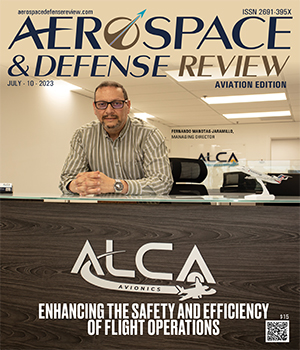
Alca Avionics Inc.: Enhancing The Safety and Efficiency of Flight Operations

Top 10 Aviation Solutions Companies - 2023

Since the Wright Brothers’ historic flight in 1903, aviation has captured the imagination of humanity, forever transforming the way we connect, explore, and understand our world. It has transformed our planet into a global village, erasing geographical barriers and bringing people and cultures closer together.

The digital revolution has reshaped nearly every aspect of our lives, and aviation is no exception. From online booking platforms to mobile check-ins and electronic boarding passes, technology has streamlined the passenger experience, making travel more convenient and efficient.

Technology has revolutionized the way aircraft are designed, manufactured, and maintained. Computer-aided design and simulation tools have allowed for more precise and efficient aircraft development, resulting in improved aerodynamics, fuel efficiency, and performance. Advanced materials, such as composites and lightweight alloys, have made aircraft lighter and more fuel-efficient, reducing their environmental impact.

Safety has always been a top priority in aviation, and technology has played a crucial role in enhancing safety measures. Advanced navigation systems, such as GPS and satellite-based guidance systems, have revolutionized air traffic management, improving precision, efficiency, and capacity. Collision avoidance systems, terrain awareness, and weather radar technologies have significantly enhanced the safety of flights.

According to Markets N Research data, the global airline industry market size was valued at USD 513.5 billion in 2022 and projected to grow to USD 635.8 billion by 2030, exhibiting a CAGR of 3.10 percent during the forecast period.

This edition of Aerospace and Defense Review highlights the key developments in aviation space and how aviation providers are leveraging the latest tech solutions and market expertise to cater to evolving customer demands and industry changes.

In this edition, we feature articles from thought leaders, including Bonny Simi, Head of Air Operations and People at Joby Aviation, and Jorge AFONSO PEREIRA, Head of Civil-Military Communications, Navigation, Surveillance (CNS), and Security Unit at EUROCONTROL.

The highlight of this publication is Alca Avionics, a renowned avionics engineering and integration firm at the forefront of innovation and excellence in the aviation industry, focusing on modernizing and maintaining avionics for general aviation, business, and military aircraft.

In this edition featuring the top aviation solutions providers, we hope you find the appropriate company to facilitate your aviation needs.
    Top Aviation Solutions Companies

    AllStar Technology
    AllStar Technology is a vertically integrated firm that was founded with the aim of its founder to lead the globe toward a world based on accuracy and quality services
    Alca Avionics Inc.
    Alca Avionics Inc. is a renowned avionics engineering and integration firm at the forefront of innovation and excellence in the aviation industry since its inception in 1993, focusing on modernizing and maintaining avionics for general aviation, business, and military aircraft.
    Alta Data Technologies
    The Alta ENET product, which has been deployed of 1000s of aircraft, demonstrated a marked improvement in 1553 data loading times, reducing flightline re-programming time by hours. This is uniquely possible with Alta’s proprietary FPGA Ethernet and 1553 real-time interfaces that maximizes throughput of the two network pipes.
    Skyworks Aeronautics
    Skyworks Aeronautics, a global trailblazer in gyronautics, is redefining the future of air travel with its cutting-edge gyroplane technology. Through the use of pioneering aerospace science, engineering, and design, the company is committed to making air travel safer, more efficient, and more cost-effective.
    Systecon
    Systecon, a software company, specializes in solutions for life cycle management, predictive maintenance, spare parts optimization, and scenario analysis. It helps commercial and defense entities achieve timely decision-making, streamlined operations, enhanced cost-efficiency, and improved profitability, propelling them to new heights of success and growth.
    Airdyne Aerospace
    Airdyne is a small private aircraft engineering, manufacturing, and aerospace research company. It was established in response to an industry requirement for timely, specialized design engineering services in support of roll-on C-130 special mission aircraft support systems. Other fixed-wing and rotary-wing aircraft applications, as well as back-end mission operational support systems, have benefited from their services.
    Avion Solutions
    Avion Solutions, Inc. is an employee-owned company that provides engineering, programmatic, logistics, and technical solutions to the United States military. It has established a reputation for excellence and dependability by consistently providing customers with innovative, high-quality solutions.
    Collins Aerospace
    Collins Aerospace is an American technology company that is one of the world’s largest suppliers of aerospace and defense products. It designs, manufactures, and services systems and components for commercial aviation, business aviation, military and defense, helicopters, space, airports, and other industries.
    Leonardo USA
    Leonardo provides robust solutions to meet the critical needs of government agencies, law enforcement, armed forces, and commercial and industrial operators. It ensures seamless access to full product offerings for military and civil markets, in addition to full design, production, and commissioning. It is uniquely positioned to meet the rapidly changing high-technology needs of defense, security, commerce, transportation, and civil resilience.
    ORANGE
    ORANGE, founded by test pilots with roots in flight and autonomous testing and evaluation, solves the difficult problems that innovative vehicle companies face. ORANGE employs industry leading Subject Matter Experts with diverse experience ranging from dynamic startups to defense operations.

Aviation Info

Q1
What Do Top Aviation Solutions Companies Do?
Top Aviation Solutions companies support the systems, services and infrastructure that keep aircraft operating safely, efficiently and in compliance with industry requirements. The category covers a wide range of providers, including aviation software developers, aircraft maintenance platforms, flight operations specialists, staffing firms, safety consultants, ground support equipment manufacturers and fleet management providers. Top Aviation Solutions often sit behind everyday aviation activities such as scheduling, dispatch, maintenance tracking, crew management and aircraft support. A small scheduling error or delayed maintenance update can quickly affect aircraft availability, costs and passenger operations.
Q2
Why Do Top Aviation Solutions Matter More Today?
The aviation sector is managing a mix of growth, cost pressure and modernization at the same time. Airlines, charter operators, cargo carriers and aviation service providers are handling larger volumes of data, stricter compliance expectations and increasingly connected fleets. Top Aviation Solutions help organizations deal with these demands without adding more manual processes or disconnected systems. Many aviation teams are also working with aging fleets while introducing newer technologies. In practice, that means operators need tools and service partners that can help manage maintenance records, staffing requirements, flight schedules and safety oversight without creating additional administrative burden.
Q3
How Should Organizations Evaluate Aviation Solutions Providers?
Organizations should look beyond product features and consider how providers perform in real operating environments. A platform may appear impressive during a demonstration, but aviation operations often involve changing schedules, maintenance disruptions, regulatory reviews and last-minute adjustments. When evaluating Top Aviation Solutions, decision-makers should assess integration capabilities, reporting accuracy, compliance support and how providers respond when disruptions occur. Running actual maintenance records or flight scheduling scenarios through the system can reveal far more than a standard sales presentation. Since most aviation teams already work across multiple systems, compatibility remains an important factor.
Q4
What Business Value Do Top Aviation Solutions Deliver?
Well-designed aviation solutions help reduce delays, improve fleet utilization and make day-to-day operations easier to manage. Aviation organizations depend on accurate information moving between maintenance teams, operations staff, pilots and compliance personnel. When information is scattered across spreadsheets, email chains or disconnected applications, mistakes become more likely. Top Aviation Solutions help centralize critical data and improve visibility across departments. The value is often seen in fewer scheduling conflicts, better maintenance planning, improved regulatory readiness and faster decision-making. A delayed aircraft can affect multiple flights and create expensive downstream disruptions.
Q5
How Are Technology and Innovation Changing Aviation Solutions?
Technology is reshaping how aviation organizations monitor aircraft, manage fleets and respond to operational issues. Many Top Aviation Solutions now incorporate automation, predictive maintenance tools, artificial intelligence and real-time data analysis. These capabilities help identify maintenance concerns earlier, improve resource planning and reduce unnecessary downtime. Aviation software providers are also placing greater emphasis on mobile access, cloud-based systems and live operational visibility. The goal is not simply to collect more data but to make information easier to use when decisions must be made quickly. In aviation, timing often matters as much as accuracy.
Q6
What Should Decision-Makers Prioritize When Comparing Top Aviation Solutions?
Organizations comparing Top Aviation Solutions should focus on reliability, service quality, implementation support and long-term usability rather than feature lists alone. A solution that fits one airline or aviation operator may not work well for another with different regulatory requirements, fleet structures or staffing models. Buyers should examine training support, system scalability, compliance capabilities and how updates are managed over time. Aviation operations rarely remain static, so flexibility matters. The strongest Top Aviation Solutions are usually the ones that continue working effectively as fleets grow, regulations change and operational demands become more complex.