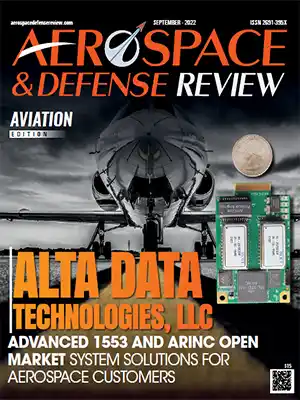
Alta Data Technologies LLC: Advanced 1553 and ARINC Open Market System Solutions for Aerospace Customers

Top 10 Aviation Solution Companies - 2022

Touched by the inevitable digital wave, the aviation industry harnesses the potential of modern technologies, including robotics, biometrics, the internet of things, and artificial intelligence. This shift is spurred by the growing competition, dynamic regulatory environment, fast-evolving customer expectations, and fuel price hikes in the aviation industry. In a forecast report, the aviation market is predicted to register a CAGR of over five percent from 2022 to 2027, with the commercial aircraft segment projected to witness the highest CAGR during the forecast period. The market is witnessing an increase in the adoption of artificial intelligence technologies, particularly in chatbots, which are becoming increasingly smarter and more sophisticated in handling and resolving customer queries.

Several manufacturers are further bolstering market growth by developing newer generation aircraft for various sectors within the aviation industry. With modern aircraft, commercial and general aviation customers are expected to benefit from increased fuel efficiency and safety, while military customers are expected to gain better situational awareness and tactical advantage.

This edition of Aerospace and Defense Review brings the spotlight on the key developments in the space and how aviation providers are leveraging the latest tech solutions and market expertise to cater to the evolving customer demands and industry changes. In this edition, we feature thought leadership articles from Jeff Moore, Sr. Director of line maintenance and technical services at Frontier Airlines, and Bruno Cervia, VP of R&D and Deputy CEO at Pilatus Aircraft Ltd. They speak about the improved use of data analytics in the predictive maintenance of aircraft and using modern technologies such as automation and 3D printing to ensure precision in the manufacturing process and accelerate production cycles.

The highlight of this publication is Alta Data Technologies, a leading supplier of MIL-STD-1553 and ARINC connectivity products, whose wide array of interface cards and real-time appliances has aided other aviation companies in offering smaller, higher-performance avionics systems at dramatically lower costs.

In this edition featuring top aviation solutions providers, we hope you find the appropriate company to facilitate your aviation needs.

Let us know your thoughts!
    Top Aviation Solution Companies

    Alta Data Technologies LLC
    Alta is one of the largest commercial-off-the-shelf (COTS) suppliers of interface cards and real-time appliances of MIL-STD-1553 or ARINC network communications products
    APAS
    As an FAA / EASA 145 Certified Repair Station with Class I, II and III Accessories rating, A Professional Aviation Services Corp. (APAS) has been at the forefront in providing customers with superior overhaul and repair services while building lasting customer relations
    Selex ES Inc.
    Selex ES Inc. is a subsidiary of Leonardo and offers navigation solutions for aircraft. They focus on the CNS space rather than on ATM. Solutions include DME, ILS, VOR and TACAN. They prioritize customer relations and on advancing the technology of their solutions to create a safer more efficient airspace.
    Orange Aero
    Founded by test pilots, ORANGE employs industry-leading subject matter experts with wide-ranging experience, from dynamic startups to defense operations. ORANGE leads in aviation/autonomous safety, flight test, certification support, and training for the innovative world of modern vehicles
    PTI Technologies
    PTI is a global leader and a solution provider in highly engineered filtration and fluid control subsystems. The company is a world leader in designing, developing, manufacturing, marketing, and distributing highly engineered filtration and fluid control subsystems and equipment
    Acquisition Integration
    Acquisition Integration strives to improve all customers’ operational and business performance by delivering strategic leadership, high-quality goods, and expert services at a low cost. Aquisition Integration, based in Huntsville, AL, is a proud Service-Disabled Veteran-Owned Small Business (SDVOSB) and SBA Certified HUBZone company that provides distribution, logistics, and services to the military and aerospace industries
    Afuzion
    AFuzion and its engineers are frequently featured in international publications like Bloomberg News, Military Embedded Systems, Intelligent Aerospace, Aviation Today, and many more
    Crestwood Technology Group
    CTG (Crestwood Technology Group) provides key components, equipment, and obsolescence management solutions to the Government & Defense and Commercial Aviation Industries in order to keep fleets and systems operating, ready, and safe. They have won awards for their quality and client service
    Dewesoft
    Dewesoft is a market leader in data acquisition equipment. They are on a quest to challenge and transform the measurement technology globe. They create solutions with the end-user experience by always thinking outside the box and holding ourselves to the highest standards
    JMA Solutions
    JMA Solutions is a growing management services organization comprised of competent and experienced experts. They are focused on exceeding their client’s expectations and furthering their purpose by offering exceptional customer service. They have provided customer assistance for Program Management, Engineering Services, Air Traffic Management, and other areas since 2005

Aviation Info

Q1
What Do Top Aviation Solutions Companies Do?
Top Aviation Solutions companies support the systems, services and infrastructure that keep aircraft operating safely, efficiently and in compliance with industry requirements. The category covers a wide range of providers, including aviation software developers, aircraft maintenance platforms, flight operations specialists, staffing firms, safety consultants, ground support equipment manufacturers and fleet management providers. Top Aviation Solutions often sit behind everyday aviation activities such as scheduling, dispatch, maintenance tracking, crew management and aircraft support. A small scheduling error or delayed maintenance update can quickly affect aircraft availability, costs and passenger operations.
Q2
Why Do Top Aviation Solutions Matter More Today?
The aviation sector is managing a mix of growth, cost pressure and modernization at the same time. Airlines, charter operators, cargo carriers and aviation service providers are handling larger volumes of data, stricter compliance expectations and increasingly connected fleets. Top Aviation Solutions help organizations deal with these demands without adding more manual processes or disconnected systems. Many aviation teams are also working with aging fleets while introducing newer technologies. In practice, that means operators need tools and service partners that can help manage maintenance records, staffing requirements, flight schedules and safety oversight without creating additional administrative burden.
Q3
How Should Organizations Evaluate Aviation Solutions Providers?
Organizations should look beyond product features and consider how providers perform in real operating environments. A platform may appear impressive during a demonstration, but aviation operations often involve changing schedules, maintenance disruptions, regulatory reviews and last-minute adjustments. When evaluating Top Aviation Solutions, decision-makers should assess integration capabilities, reporting accuracy, compliance support and how providers respond when disruptions occur. Running actual maintenance records or flight scheduling scenarios through the system can reveal far more than a standard sales presentation. Since most aviation teams already work across multiple systems, compatibility remains an important factor.
Q4
What Business Value Do Top Aviation Solutions Deliver?
Well-designed aviation solutions help reduce delays, improve fleet utilization and make day-to-day operations easier to manage. Aviation organizations depend on accurate information moving between maintenance teams, operations staff, pilots and compliance personnel. When information is scattered across spreadsheets, email chains or disconnected applications, mistakes become more likely. Top Aviation Solutions help centralize critical data and improve visibility across departments. The value is often seen in fewer scheduling conflicts, better maintenance planning, improved regulatory readiness and faster decision-making. A delayed aircraft can affect multiple flights and create expensive downstream disruptions.
Q5
How Are Technology and Innovation Changing Aviation Solutions?
Technology is reshaping how aviation organizations monitor aircraft, manage fleets and respond to operational issues. Many Top Aviation Solutions now incorporate automation, predictive maintenance tools, artificial intelligence and real-time data analysis. These capabilities help identify maintenance concerns earlier, improve resource planning and reduce unnecessary downtime. Aviation software providers are also placing greater emphasis on mobile access, cloud-based systems and live operational visibility. The goal is not simply to collect more data but to make information easier to use when decisions must be made quickly. In aviation, timing often matters as much as accuracy.
Q6
What Should Decision-Makers Prioritize When Comparing Top Aviation Solutions?
Organizations comparing Top Aviation Solutions should focus on reliability, service quality, implementation support and long-term usability rather than feature lists alone. A solution that fits one airline or aviation operator may not work well for another with different regulatory requirements, fleet structures or staffing models. Buyers should examine training support, system scalability, compliance capabilities and how updates are managed over time. Aviation operations rarely remain static, so flexibility matters. The strongest Top Aviation Solutions are usually the ones that continue working effectively as fleets grow, regulations change and operational demands become more complex.